Buying Guides
How to Buy a Diamond in Tampa Bay
Buying a diamond in Tampa Bay is not hard once you understand what you are looking at. The trick is that most first time buyers walk into a jewelry store without much context for what the price tag reflects. This guide walks through the parts that actually matter, the parts that do not, and a few things local buyers in Pasco and Pinellas county tend to ask about once they are standing at the counter.
Start with a real budget, not a rule of thumb
You may have heard the old saying about spending two or three months of salary. It is a marketing line from the 1930s and it has no particular authority. A better approach is to pick a number you are comfortable with, then work a stone and setting to fit it. Prices on loose diamonds move with the wholesale market, which is why many independent jewelers (us included) post “Market Price” rather than fixed figures on individual stones.
If your budget is flexible inside a range, say it out loud. A jeweler can show you what is achievable at $3,000, $5,000, $8,000, and $12,000 and you can decide from there. Nobody who is worth your time will push you over the top of the range.
The 4 Cs, in the order that actually matters
The Gemological Institute of America grades every certified diamond on four axes: cut, clarity, color, and carat weight. Textbooks list them in that order. In practice, most buyers walk in thinking about size first, which is fine, but here is how we would weight them when evaluating a stone in the case.
Cut comes first. Cut is the craftsmanship of the stone, the angles and proportions that make it return light to your eye. A well cut stone looks brighter, whiter, and larger than a poorly cut stone of the same carat weight. This is the single most important factor in how a diamond looks on a hand. A half carat with an excellent cut will often out-sparkle a three quarter carat with a mediocre cut.
Color is second. Diamonds run D (colorless) to Z (noticeable yellow or brown). The near-colorless range (G, H, I, J) is where most buyers land because the stones face up white in daylight and in ring settings, and the price drops sharply as you move down the scale. D through F are the top grades and carry a premium.
Clarity is third. Most flaws you will hear about are inside the stone and invisible without magnification. SI1 and SI2 (slightly included) are usually eye clean, meaning you cannot see the inclusion without a loupe. Stones in the VS range (very slight) are eye clean with a safety margin. Unless you intend to wear a loupe on a chain around your neck, VVS and IF are mostly paying for a grading letter.
Carat weight is fourth. Carat measures weight, not size. Two half carat diamonds can look noticeably different if one is cut shallow and the other deep. Pay more attention to millimeter measurements when you are comparing stones.
Certification: insist on GIA for anything meaningful
If a stone is being sold as certified, the certification should come from the Gemological Institute of America. AGS is also legitimate. Other lab reports exist and some are fine, but GIA is the reliable baseline and the report is the document that follows the stone if you ever insure, sell, or re-appraise it.
At our store we have a GIA Graduate Gemologist on site. That matters because grading is a trained skill. We do it in front of you when you are buying, and we do it when customers bring stones in to sell. If someone is selling you a diamond without a GIA report, the stone might still be excellent, but the price should reflect that the grading is the seller’s word rather than a credentialed third party’s.
Setting before stone, or stone before setting?
Either order works. In practice, it depends on what pulls you in first.
If the setting matters most (a specific halo design, vintage style, bezel, three stone layout), start with the setting and pick a stone that fits the setting’s center stone dimensions.
If the stone matters most (you want a specific carat weight, or you are drawn to a particular cut or color grade), start with the stone and pick or design a setting around it.
Most of our engagement ring customers start somewhere in between. They have a general sense of what they like and we narrow it down together. Custom rings in our shop typically take two to four weeks from approved design to a finished piece.
Shape choices, in plain terms
- Round brilliant. The classic. Most light return, most forgiving of minor flaws, widest resale market. Tends to face up smaller per carat than fancy shapes because the cut is deep.
- Princess. Square, modern, sharp corners. Second most popular after round. Corners are the vulnerable part if the setting does not protect them.
- Emerald. Rectangular step cut. Understated sparkle, more of a “hall of mirrors” look than a fireball. Color and clarity show more, so pay attention to both.
- Oval. Elongated brilliant. Finger flattering, face up larger than round per carat. Watch for the “bowtie” shadow in the center of poorly cut ovals.
- Pear. Drop shaped. Also can show a bowtie. Distinctive, not for everyone.
- Cushion. Square or rectangular with rounded corners. Vintage feel, pillowy look.
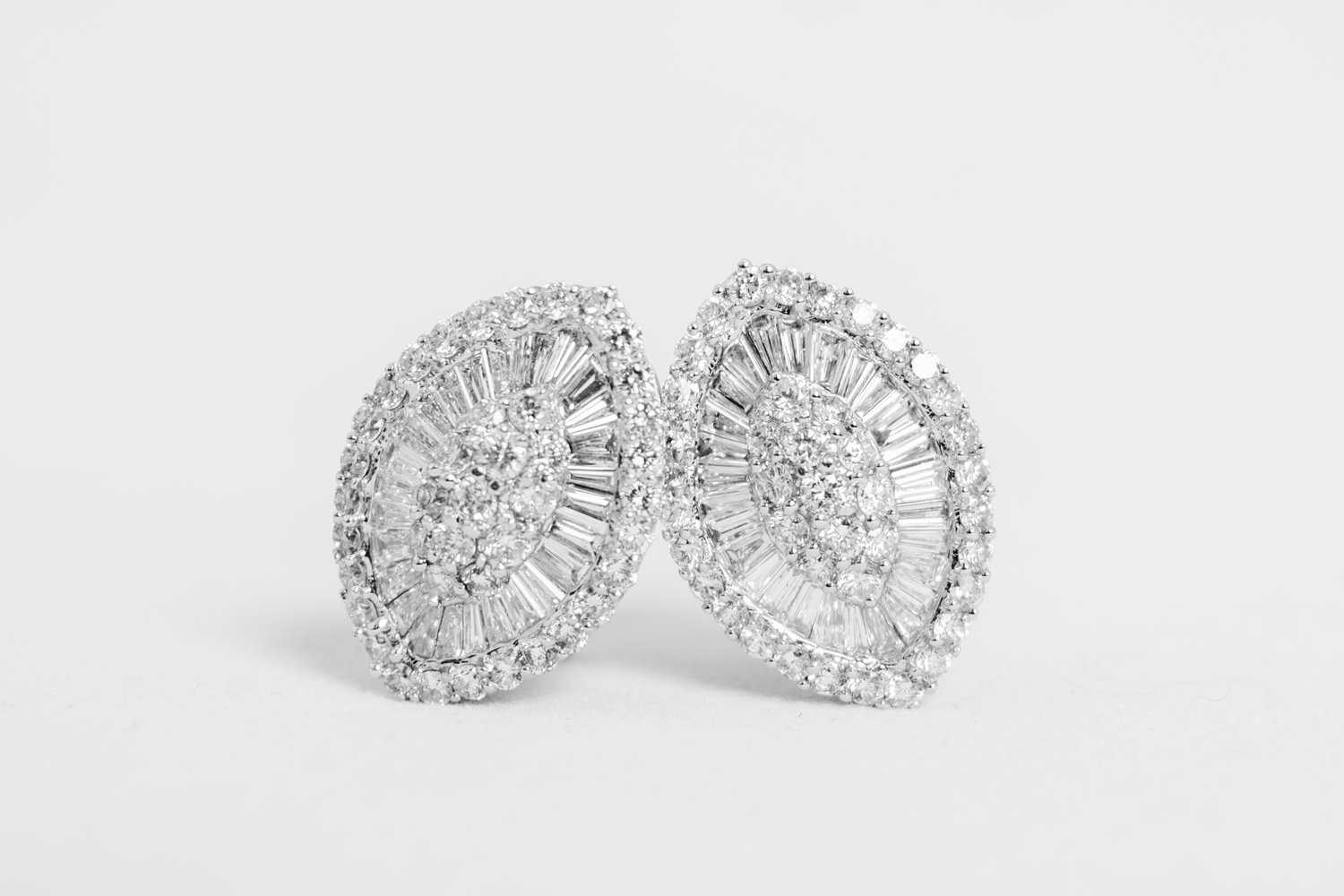
- Marquise. Pointed oval. Dramatic, flatters slender fingers, looks larger than its carat weight suggests.
- Hexagon, asscher, radiant. Less common, strong personality, require a setting that respects the geometry.
There is no “best” shape. There is the one you keep coming back to when we put a tray of loose stones in front of you.
Metal and setting basics
The three most common metals for engagement rings are 14k white gold, 14k yellow gold, and platinum. Rose gold is a fourth option that has stayed popular. Platinum is the densest, most durable, and most expensive. White gold is plated over a nickel or palladium alloy and needs occasional re-plating to keep the bright white finish. Yellow and rose gold wear evenly and do not require re-plating.
Settings vary from plain solitaires to complex halos, three-stone designs, and pave or micropave bands that can hold dozens of small accent diamonds. Heavier settings protect the stone better but also hide it more. Every setting is a trade-off between security, visibility, and style.
Financing and payment
Most jewelers in Tampa Bay will take credit card, debit, and cash. Many of us offer financing for qualified buyers through third party partners. Some offer layaway. If financing matters, ask what is available before you walk in, and run the numbers against a credit card with a 0% promotional window, which is sometimes cheaper.
Red flags worth knowing
- A “deal” that is far below wholesale. Stones have a market. If someone is 30% under the going rate on comparable inventory, either the grading is generous, the stone has a problem, or something is off about the transaction.
- No certification on a stone priced as certified. If the price reflects certification, the paper should be in the drawer.
- Pressure to decide today. A good engagement ring purchase is not a limited time offer. Any honest jeweler will hold a stone while you think.
- Vague answers about treatment. Clarity-enhanced and color-treated diamonds are legitimate products but they sell for a fraction of untreated stones. If you ask “is this stone treated?” you should get a clear yes or no.
What to do when you walk in
- Tell us roughly what you have in mind and what you are comfortable spending. A range is fine. We will show you what falls inside the range before we show you anything above it.
- Look at stones in daylight, in store lighting, and under magnification. Ask to see the GIA report. Ask to see the stone in the hand of a model-size finger or a finger gauge.
- Pick a setting once the stone is chosen, or bring an inspiration image if you already know the setting. If the piece needs to be custom, we will sketch it and quote it before we start.
- Do not sign anything on the first visit unless you are certain. Any reputable jeweler will hold the stone for a few days.
Worth visiting us from elsewhere in Tampa Bay?
Most of our customers drive in from Tarpon Springs, Palm Harbor, New Port Richey, Clearwater, and Dunedin. Tampa and St. Petersburg customers usually come because they want wholesale pricing, a family jeweler rather than a chain, and a GIA graduate gemologist grading the stone in front of them. The drive up U.S. Highway 19 is straight forward. We are at 2338 U.S. Highway 19 N in Holiday with parking in front of the store.
You can also call (727) 491-3344 before you come out to check whether we have a specific shape or size range in the case, since loose diamond inventory rotates.
Questions? Stop in or call.
Florida Diamond Center is at 2338 U.S. Highway 19 N, Holiday, FL 34691. We are open Monday through Friday 10 AM to 6 PM, Saturday 10 AM to 5 PM.
More on Buying Guides
Engagement Ring Sizing Guide: How to Get It Right the First Time
Practical tips for measuring ring size accurately, from a jeweler who sizes rings in-house. Covers surprise proposals, knuckle sizing, temperature, and when to re-size.
Insuring Your Engagement Ring in Florida: What to Know
How engagement ring insurance works in Florida, what it costs, what documents you need, and how to pick a policy that actually covers a lost ring.